Salad Surprises

Salad Surprises

Salads, by nature, are supposed to be healthy, right? Many times they are, like a side house salad of lettuce, tomato and cucumber with light vinaigrette meant to compliment a meal. Yet entrée salads can top 1000 calories and include a full day’s supply of fat and sodium! The mixed greens and vegetables aren’t to blame. And while the healthy plant fats (nuts, olives and avocado) can add significant calories, these are preferable to the real culprits* – bacon, cheese, dressing and fried toppings. Sugar can be hidden in there, too! In most cases, it’s the fat that pushes the calories up over a desirably-sized meal of around 600-800 calories.

Menu descriptions are a good indication of where you might find salad surprises. Words like crispy, creamy, glazed and savory are red flags to watch out for.  Portion sizes make a difference, too. While you might fill a bowl with 2 cups of salad at home, a dinner plate piled high could give you twice that much. Note that the quantity of dressing served on a salad is typically 2 fl. oz. and provides 150-200 calories of the below totals.

Let’s take a look at a few examples you might find nationally (from restaurant chains with over 1000 locations in the U.S.). In all cases only the grilled meat option is discussed, as breaded and fried proteins are just a no-no.  Notable high values are underlined. *Can you find these culprits and others below? 

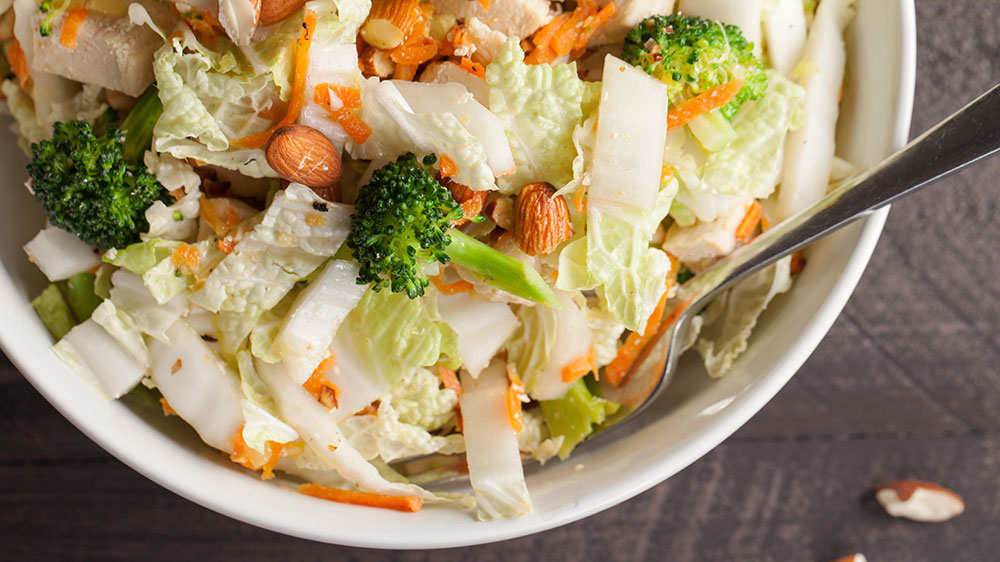
Asian-Inspired Chicken Salad

Greens tossed in a sweet vinaigrette and topped with crispy noodles, toasted almonds and grilled chicken.

1290 calories, 85 gm Fat (59% cals), 2300 mg sodium, 52 gm sugar

Southwestern, BBQ, or Santa Fe Salad

w/ steak — mixed greens, sirloin w/ chimichurri, corn & black bean salsa, cheddar cheese and tortilla strips w/ creamy cilantro ranch dressing.

990 calories, 64 gm fat (58% cals), 2970 mg sodium, 8 gm sugar

w/ chicken (deluxe) – grilled BBQ chicken, romaine and kale, green onion, tomato, black beans and corn, cucumber, red onion, cilantro, cheddar cheese, avocado, bacon and tortilla strips, tossed in BBQ ranch dressing and topped with onion strings.

910 calories, 48 gm fat (47% cals), 2390 mg sodium, 24 gm sugar

w/ chicken (simple) – grilled chicken, pico de gallo, avocado, cilantro, tortilla strips w/ ranch & Santa Fe sauce.

630 calories, 44 gm fat (62% cals), 1680 mg sodium, 8 gm sugar

Specialty Salads

Crispy pecan-crusted chicken breast, romaine and kale, celery, dried sweet cranberries, orange slices, glazed pecans, blue cheese, tossed in balsamic vinaigrette.

1220 Calories, 84 gm fat (62% cals) 1770 mg sodium, 52 gm sugar

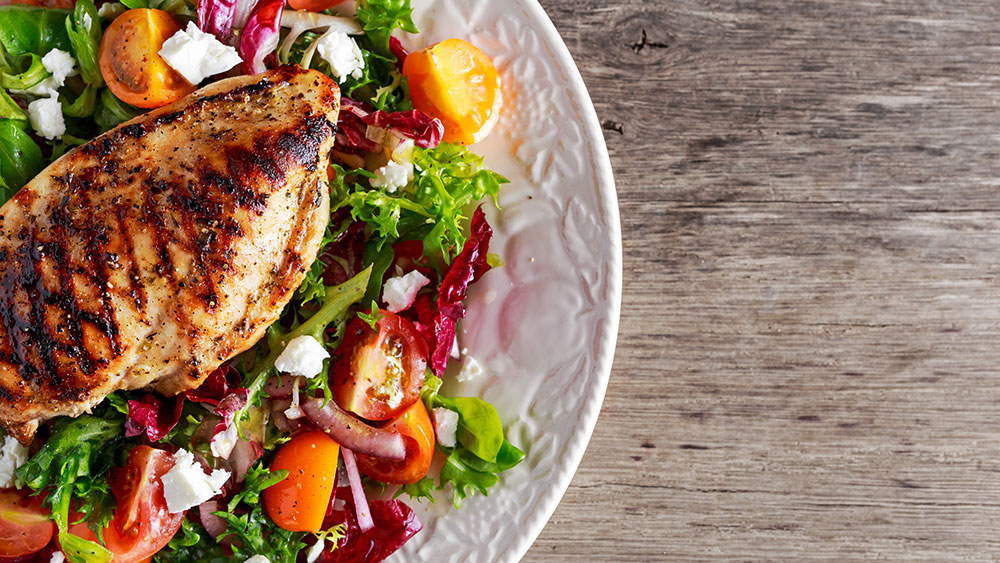
Grilled chicken, mixed greens, jalapeno cornbread croutons, tomatoes, cheddar cheese, bacon and green onions w/ ranch dressing.

1090 calories, 70 gm Fat (58% cals), 2620 mg sodium, 17 gm sugar

Grilled chicken, pineapple, mandarin oranges, dried cranberries, diced red bell peppers, chopped green onions, cilantro & sesame seeds w/ a honey-lime dressing.

710 calories, 27 gm fat (34% cals), 1140 mg sodium, 70 gm sugar

How to get a healthier salad:

  • Ask to hold, substitute or go light on the items in red above.
  • Request a lunch portion of the salad (if offered on menu).
  • Often, just adding a lean protein and beans or other complex carbohydrate to a house salad will make it suitable as a balanced meal.
  • Ask for dressings on the side so you can control how much you use.
  • Ditch the dressing and opt for oil and vinegar to pare down the sodium by half!

*Culprits listed in order of appearance are: sweet vinaigrette, crispy noodles, cheddar cheese, tortilla strips, cheddar cheese, creamy cilantro ranch dressing, BBQ, cheddar cheese, bacon, tortilla strips, BBQ ranch dressing, onion strings, tortilla strips, ranch, santa fe sauce, dried sweet cranberries, glazed pecans, blue cheese, balsamic vinaigrette, cornbread croutons, cheddar cheese, bacon, ranch dressing, dried cranberries, honey-lime dressing.

LA Fitness Living Healthy subscribe button

Want more? SUBSCRIBE to receive the latest Living Healthy articles right in your inbox!

Sources as of 7/7/2017:

www.Applebees.com/nutritional-info

www.tgifridays.com/pdf/nutrition.pdf

www.chilis.com/docs/Chilis-Nutrition-Menu-Generic.pdf

Recommended Reading

Good carbs vs bad carbs
Debunking Diet Myths

Debunking Diet Myths

With so many sources offering nutrition advice, it’s hard to know what’s true. Even factual information can become distorted by the time it reaches you. Like a game of telephone, the message often changes as it’s passed along. Here, we debunk 5 common diet myths to...

Soups For Every Season

Soups For Every Season

It doesn’t have to be cold out to enjoy a good nourishing soup. Some soups pair perfectly with salads and sandwiches while others are complete meals in themselves. Whether you like a smooth puree or a chunky feast, there are soups just right for your taste buds.

Before choosing your soup, first and foremost, consider the freshness. A homemade soup of nearly any kind will be far more nutritious than a canned choice. Restaurants and delis often serve soup made the same day. Consider preparing yours in a slow-cooker in the morning for you to enjoy in the evening.

One of the joys and benefits of soup is that it’s eaten only a spoonful at a time. This slows the pace of your meal so you can truly savor your soup and potentially eat less. Taking time to enjoy your food helps nourish the soul and provides a chance to unplug for a while.

Here are our seasonal suggestions for soup year-round, though you can work in your favorites (except high-fat, cream-based bisques) anytime:

Fall  

  • Butternut Squash
  • Roasted Red Pepper
  • Carrot Ginger
  • Potato
  • Split Pea
  • Lentil
  • White Chicken Chili
  • Bean and Ham
  • French Onion

Winter  

  • Chowders – Clam, Corn, Artichoke
  • Chili
  • Minced Stew
  • Pho
  • Albondigas
  • Chicken Tortilla
  • Pozole

Spring 

  • Chicken Noodle
  • Chicken Wild Rice
  • Cream of Mushroom
  • Cream of Broccoli
  • Cream of Asparagus
  • Tortellini
  • Italian Wedding
  • Beef Ragu
  • Beef Vegetable Barley

Summer 

  • Cold – Gazpacho, Yogurt Cucumber, Vichyssoise
  • Tomato
  • Thai curry shrimp
  • Miso w/ Tofu
  • Egg Drop

Check out recipes for great soups like these at the American Diabetes Association’s “My Food Advisor®” by clicking here and also from the American Heart Association by clicking here.

Top with garnishes such as basil, cilantro, green onion, parsley, dill, red chili flakes, pepitas (pumpkin seeds), mini croutons, bacon bits, shredded Parmesan, dollop of crème fraiche, sliced avocado or radish for both flair and texture.

Bon Appétit!

LA Fitness Living Healthy subscribe button

Want more? SUBSCRIBE to receive the latest Living Healthy articles right in your inbox!

Recommended Reading

Let’s Talk: Coconut Oil | Q+A

Let’s Talk: Coconut Oil | Q+A

Question:

I love coconut oil for all my beauty needs & I eat it too! What do you think of all the hype?

– Liberty J.

Answer:

To answer your question directly: I don’t pay attention to hype, except to follow what consumer trends are so we can respond to them accordingly. Happy Reading 🙂

My professional observation is that “they” in the media provide sensational news even if it contradicts their own previous reporting. But that may just be reflecting the flow of nutritional research. For example, fat was bad in the 1980’s and the Pritikin diet plan was popular. Then we found that only saturated and trans fats are bad. Now we know there are benefits to certain types of fats, like omega-3 fats. Enter the 2015 Dietary Guidelines: “A healthy eating pattern includes… oils.” You’ve got to look at the overall trend in research, not just single studies or news headlines.

Coconut oil as a consumable product is very high in saturated fats. The names of these fatty acids are known as lauric, myristic, palmitic, caprylic, capric, and stearic acid. Of these, the greatest present is lauric acid, a type of medium-chain fatty acid. Research in the last 10 years indicates supplemental coconut oil raises total cholesterol, LDL and HDL cholesterol levels. This may not lead to adverse cardiovascular outcomes, but why not do better? Replacing animal fats with omega-3 rich fats or unsaturated plant fats (they don’t raise LDL) shows cardio-protective benefits.

Coconut water and the meat of the fruit are nutritionally fine. It takes a whole cup of coconut meat to reach the fat content in just 2 Tbsp. of coconut oil, and you also get a decent amount of fiber with it. Coconut water is full of electrolytes and has negligible fat. Coconut milk, on the other hand has varying levels of fat depending on its dilution and preparation (canned for cooking vs. beverage style).

– Debbie J., MS, RD

This article should not replace any exercise program or restrictions, any dietary supplements or restrictions, or any other medical recommendations from your primary care physician. Before starting any exercise program or diet, make sure it is approved by your doctor.

Some questions have been edited for length and/or clarity.

LA Fitness Living Healthy subscribe button

Want more? SUBSCRIBE to receive the latest Living Healthy articles right in your inbox!

Ask our Dietitian

Have a nutrition question? Our registered dietitian is ready to help!
Email nutrition@lafitness.com or submit your question below and it may be featured in an upcoming article!

8 + 6 =

Recommended Reading

Prostate Cancer & You | Q+A

Prostate Cancer & You | Q+A

Question:

I am a 57-year-old male who was a professional football player and athlete all my life. I happened to get Prostate cancer, which is being controlled by Elligard, which is hormonal therapy. Look it up to view the side effects. It reduces my testosterone down to nothing, to not feed the cancer cells.  I do one hour of cardio every night {Low intensity and hi intensity mixed} I also due upper body workouts twice a week with four different exercises per body part and two sets of twenty per. I end up with 160 reps per body part for entire upper body all within an hour. Same with legs. I lost 25% of muscle mass because of medicine.

I am a certified NASM and AFAA personal trainer for years but suck at nutrition. 1/2 quart of egg whites and avocado for breakfast, tuna or chicken salad with horseradish sauce for lunch and lean turkey, fish or chicken for dinner. Usually not any carbs unless I have multi grain bread with tuna or chicken. Two scoops of protein a day with water. Need to find a way to maintain and increase a little muscle mass with nutrition. Hope you have ideas.

– Rocky C.

Answer:

Okay Rocky, I looked it up! The drug you refer to has base name leuprolide and I’ve noted its mechanism of action and side effects. Check. That doesn’t change the fact that testosterone is helpful, but not required for gaining lean mass. Women with only 1/10 the testosterone of men can get quite muscular!  Research supports the notion that with progressive resistance training, men with prostate cancer taking anti-androgens can still increase muscle mass and strength.

I hope you are open to changing up your diet (which currently reflects what someone might eat to slim down). To feed your muscles and prompt them to grow in response to your admirable workouts, you’ll need more calories, notably from fats and carbohydrates. As you know, carbohydrates help stimulate the release of insulin, which is a growth-triggering hormone. Insulin’s anabolic effects in the muscle are three-fold: it helps prevent the breakdown of protein, enhances glucose uptake into cells for energy and building, and promotes protein synthesis.

To make your body’s natural insulin work for you, proper nutrient timing and intensive weight training are critical. Priming your system before a workout (to increase circulating insulin in anticipation of a macronutrient load later) is key to taking advantage of insulin’s normal post-digestive metabolic process. To do so, you should eat 15-30 grams low-glycemic (complex) carbohydrate about a half-hour before the start of your lifting/resistance work, then have 30 grams of easily-digestible (simple) carbohydrate at the end of your workout or within 30 minutes while muscle is most receptive to nutrient storage. Each of these should be paired with an equivalent amount of protein. Low-glycemic carbs include sweet potato, oatmeal, quinoa and beans. Easily-digestible carbs include flake cereals, white crackers and pretzels, and pasta.

In addition, for overall calories and micronutrients, I’d suggest adding a variety of nuts and vegetables to your day. Good luck!

– Debbie J., MS, RD

This article should not replace any exercise program or restrictions, any dietary supplements or restrictions, or any other medical recommendations from your primary care physician. Before starting any exercise program or diet, make sure it is approved by your doctor.

Some questions have been edited for length and/or clarity.

LA Fitness Living Healthy subscribe button

Want more? SUBSCRIBE to receive the latest Living Healthy articles right in your inbox!

Ask our Dietitian

Have a nutrition question? Our registered dietitian is ready to help!

Email nutrition@lafitness.com or submit your question below and it may be featured in an upcoming article!

9 + 13 =

Recommended Reading

Food Options to Drop Weight & Tone | Q+A

Food Options to Drop Weight & Tone | Q+A

Question:

Good afternoon, my name is Howard G., and I am a member of LA Fitness. I am a 49-year-old male, I weigh 294 lbs., and I am 6’2″.  I have been consistently working out for the past two weeks. I would like to know what would be the ideal calorie intake along with what specific foods should I consume. I am looking to drop weight which is my first goal and then to tone my body. Whatever help you can give me will be much appreciated.

– Howard G.

Answer:

Hello Howard. You really don’t want to count 2000+ calories, do you? I suspect that your interest in “what specific foods” to eat lies more in a desire to follow a plan laid out for you than in constructing one with a large/vague limit like total calories.

In suggesting a sample diet plan for you as an individual, I’d ask you to consider what are the dietary changes you know you need to make and which are the ones you are willing to consistently apply? For example, fried foods may be a problem but unavoidable in your work/social environment yet you only eat sweets because they are there, so could

consciously skip those. Often I observe that one’s diet is reasonable and he just needs to reduce portions across the board. Hint, hint.

That said, IN GENERAL, a 2000-2200 caloric intake that reflects that following meal pattern could be a place to start for the next couple of weeks for someone not used to managing his intake at all.

2 cups FRUIT

1 cup of fruits counts as:

  • 1 cup raw or cooked fruit; 1/2 cup dried fruit; or 1 cup 100% fruit juice

3 cups VEGETABLES

1 cup vegetables counts as:

  • 1 cup raw or cooked vegetables; 2 cups leafy salad greens; or 1 cup 100% vegetable juice

6 ounces GRAINS

1 ounce of grains counts as:

  • 1 slice bread; 1 ounce ready-to-eat cereal; or 1/2 cup cooked rice, pasta, or cereal

6 ounces PROTEIN

1 ounce of protein counts as:

  • 1 ounce lean meat, poultry, or seafood; 1 egg; 1 Tbsp. peanut butter; 1/4 cup cooked beans or peas; or 1/2 ounce nuts or seeds

2-3 cups DAIRY

1 cup of dairy counts as:

  • 1 cup milk; 1 cup yogurt; 1 cup fortified soy beverage; or 1 1/2 ounces natural cheese or 2 ounces processed cheese

Remainder of calories from 3 servings of healthy plant fat.

The above is based on the 2015 Dietary Guidelines which are supported in the ChooseMyPlate.gov recommendations and MyPlate checklists.

Laid out across meals and snacks with examples, it may look something like this:

Breakfast

1 fruit: small 5” banana

2 grain: 2 whole wheat waffles

1 fat: Tbsp. peanut butter

1 dairy: 8 fl. oz. 1% milk

Lunch

2 vegetable: 2 cups raw spinach

3 protein: half roasted chicken breast

1 grain: ½ C. white beans

1 fat: 2 Tbsp. reduced-fat salad dressing

Dinner

1 vegetable: ½ C cooked broccoli

3 protein: 3 oz. salmon

2 grain: 1 cup cooked brown rice

Snacks

1 grain: 3 C. popcorn

1 fat: tsp. oil for popping

1 fruit: 1 cup melon

– Debbie J., MS, RD

This article should not replace any exercise program or restrictions, any dietary supplements or restrictions, or any other medical recommendations from your primary care physician. Before starting any exercise program or diet, make sure it is approved by your doctor.

Some questions have been edited for length and/or clarity.

LA Fitness Living Healthy subscribe button

Want more? SUBSCRIBE to receive the latest Living Healthy articles right in your inbox!

Ask our Dietitian

Have a nutrition question? Our registered dietitian is ready to help!

Email nutrition@lafitness.com or submit your question below and it may be featured in an upcoming article!

12 + 5 =

Recommended Reading