How Much Protein Should I be Eating? | QA

How Much Protein Should I be Eating? | QA

Question:

I am a 38 year-old male, 250 pounds, 5’11” and I’ve been steadily working out since June and have lost almost 50 pounds, but I’m curious what is the right amount of protein that I should be taking in daily? I work out 5 or 6 days a week on average and work with a personal trainer six times a month. I usually do about 30-45 minutes of strength training followed up by 30-45 minutes of cardio. I’m currently shooting for somewhere between 130-180 grams of protein a day. Is that enough for my goal of losing weight while building muscle? Thanks.

-Steven M.

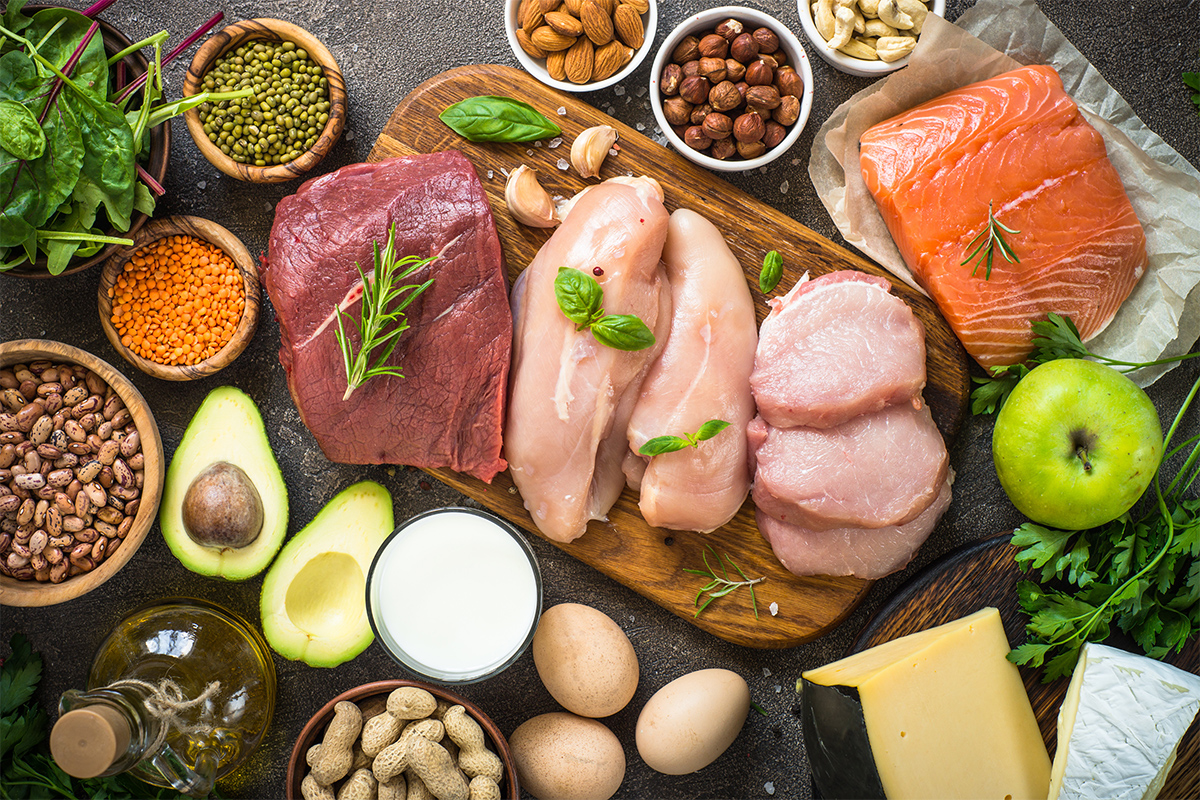
Great work on your consistent progress, Steven! For your body weight, goals and activity level your current aim for 130-180 grams of protein daily seems on track. That’s between 1.1 and 1.6 grams of protein per kilogram body weight, ideal for supporting muscle growth with an intensive workout regimen. The range midpoint of 155 grams provides 620 calories which would equate to about 30% of energy if your intake was 2000-2100 calories. 

Though you may be counting protein grams and calories, the quality and timing of what you’re eating has as much impact as – if not more than hitting calculated marks. Remember to support your workouts with some carbohydrate and a little protein in your recovery snack. A high-protein yogurt with fruit or granola works as well as a protein shake. For your main meals, lean proteins, vegetables, whole grains and healthy plant fats will promote efficient metabolism better than typical fare. For example, choose a healthy stir-fry (e.g. chicken, carrots/broccoli, cashews, brown rice) instead of a cheeseburger (regular ground beef, cheese, refined flour bun). 

This article should not replace any exercise program or restrictions, any dietary supplements or restrictions, or any other medical recommendations from your primary care physician. Before starting any exercise program or diet, make sure it is approved by your doctor.

Some questions have been edited for length and/or clarity.

Ask our Dietitian

Have a nutrition question? Our registered dietitian is ready to help!

Email nutrition@lafitness.com or submit your question below and it may be featured in an upcoming article!

2 + 2 =


Recommended Reading - Q+A

How to Build the Illusion of Broad Shoulders

How to Build the Illusion of Broad Shoulders

After seeing it on every male model and superhero, you want that tapered V-shape, the one that draws attention to well-built shoulders, strong pectorals, pronounced lats, and a slim waist. Regardless of your natural body type, it is possible to achieve the look (or at least come close) if you work on certain muscles. Now, while healthy bodies are the best bodies, we know that a lot of people are working towards a specific aesthetic. If you’re aiming for that V-shape, we’re spilling the secrets to how it’s done.  

The Inverted Triangle

You might think that just because you naturally have narrow shoulders, you will never be able to achieve that inverted triangle body shape. We’re here to tell you, you’re wrong! 

 The V-shaped physique has more to do with the muscles you work than it has to do with your natural build. There are men out there with a bit of an advantage because of their bone structure. All that really means is that they don’t have to work as hard to attain the V-shape, but they still have to work for it.  

Workouts to Shred a V-Shaped Torso

As you may have gleaned from the first paragraph, training certain upper-body muscle groups will help you achieve this look. Specifically: your traps, shoulders, pectorals, and even your lats. The goal is to build those muscles up and trim your waist down. This is what gives the illusion of broad shoulders even if you’re born with a narrow build. 

Here are some workouts that are no illusion. They’ll train you hard and help you build a powerful body that isn’t just about the aesthetics.  

The Deltoid Muscle

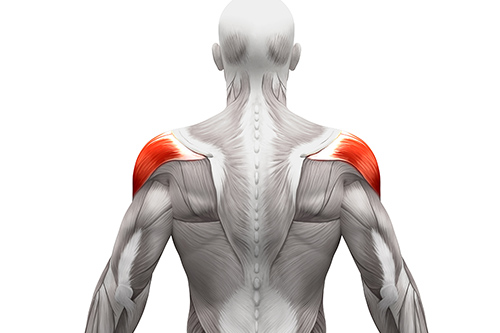
The deltoid is a muscle that is commonly referred to in 3 parts: the front, the back, and the sides. To get a uniform look, you’ll need to do different exercises that target all three, or compound exercises that target multiple sections at once. 

Lateral Raises

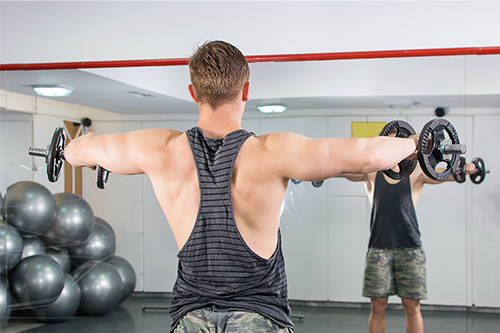
Lateral Raises work the lateral deltoids, or the sides of the deltoid. These muscles really push your shoulder circumference out as they grow.  

To do a lateral raise, choose a slightly lighter set of dumbbells that is not difficult for you to hold. From a standing position, and with your elbows slightly bent, raise the weights up from your sides and up to shoulder height, then lower them back down. The important thing is to do this movement with control. Don’t let gravity assist you! Do the movement slowly to get the most out of the exercise.  

Arnold Press

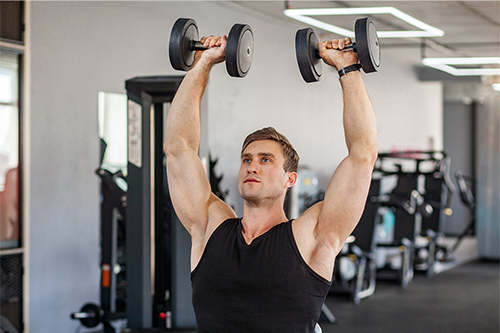
The Arnold Press will target your anterior (front) deltoids. It looks something like a regular shoulder press but there is a rotation involved that asks for a little bit more from your shoulders.   

From a seated position, raise your dumbbells to your chest with your palms facing you. This is your starting position for the move. Next, raise the dumbbells up until your arms are straight. As you do this, rotate your palms so that they are facing away from you by the time they reach the top of the move. Complete the press by lowering and rotating the weights to their original position.  

Bent Over Reverse Fly

This one is for the posterior (back) deltoids. It’s very much like the lateral raises except you’ll be bending at the hip.  

Hold your weights and stand with your knees slightly bent. Bend at the hip while keeping your back flat. Your torso should be like a solid board on your body; there should be no slouching or slumping when you bend. Keeping a slight bend in your elbows, lift both of your arms out to the side and act as if you’re trying to squeeze your shoulder blades together. Then, lower the weights back to their starting position.  

The Trapezius Muscle

Now let’s work the traps. Big traps will give you a more rounded look and beef up your neck too. 

Shrugs

Shrugs are a great exercise to target this muscle, not to mention the technique is very simple. Hold a dumbbell in each hand or hold a single barbell. Simply shrug your shoulders to move the weight a few inches up and down. 

Chest Muscles

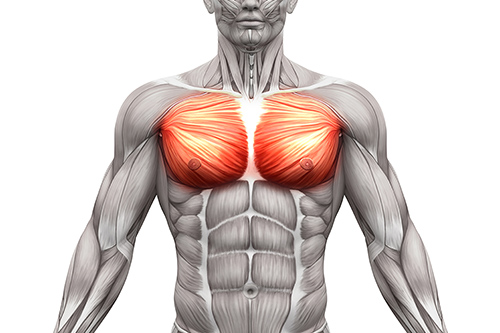
The Bench Press is perfect for targeting your chest muscles. Throw in an incline and now you’re asking the upper part of your chest to do more work. This is what gets your pecs to look more pronounced.  

Incline Bench Press

With your hands gripping the bar about shoulder width apart, and your palms facing away from you, lift the bar from the rack and hold it with your arms fully extended. In a smooth and controlled movement, bring the bar down to your chest and slowly push it back up to its starting position. You can also do this exercise with dumbbells.

Latissimus Dorsi Muscle

Get your lats into gear with the bent over row. As you can see by the diagram, the latissimus dorsi naturally taper in width. It makes sense that bulking up your lats can give you a broader appearance up top which easily adds to the V-shape you’re going for.  

Bent Over Row

There are a couple of different ways to perform this exercise, but we’ll focus on the single-arm row. Use a flat bench to support your knee and your hand on one side. The leg on the floor should be straight, as should the arm that’s resting on the bench. Grip a dumbbell with your free hand and fully extend it down towards the ground. This is your starting point. Focus on engaging your lats to pull the weight up to your chest and to lower it back down. 

Things to Consider

Though we specify certain muscle groups for each exercise, keep in mind that you’ll still get plenty of overlap in the muscles you engage with each workout. So, while that gives you a more well-rounded workout, you’ll want to be conscious of how you combine the exercises to avoid overusing certain muscles. Always pay attention to pain or discomfort and use good judgment any time you’re moving weights. 

For more workout tips and ideas, read our post on the Top 10 Most Popular Exercises and How to Perform Them Properly. Not a fan of free-weights? Crush your shoulder workout with these 5 Cable Exercises. To stay informed, subscribe to our newsletter to receive monthly highlights from the LA Fitness blog! 

Should You Go High-Protein on Days You Don’t Exercise? | QA

Should You Go High-Protein on Days You Don’t Exercise? | QA

Question:

Hi there! I am an LA Fitness member and would love to get some advice from a dietitian regarding my exercise/nutrition plan. 

I’m 31-year-old female and have always been lean – genetics/high metabolism I guess. While I know this is what many women want, my problem is that I feel “too skinny.”  I’m starting to try heavier weight training and increasing my protein intake, while striving to maintain a balanced diet. I have young kids and can only make it to the gym 1-2 days per week. So, my main question is: on days that I don’t exercise, should I still try to eat higher protein? Or is that only on gym days? 

Also, if you could verify my calculations… I’m currently around 120lbs and would like to be closer to 130lbs. So, I’m aiming for roughly 2,100-2,200 calories/day and about 125 grams of protein per day. 

Any other advice is greatly appreciated!  Thanks,  

– Shannon

Answer:

Lucky for you Shannon, carrying and lifting growing tykes is like having a built in progressive resistance program! Well… for a few years at least, until it becomes unnecessary and impractical. While it still works, you should pick up and carry toddlers with proper posture and body mechanics. According to physical therapists and chiropractors, don’t balance your child on one hip but hold him/her in front of you with his/her legs wrapped around your waist.  

In regards to your calculations: functional and structural protein use tops out at around 2.0 gm/kg/day with any excess being used for energy. Consuming about 110 gms protein daily should be sufficient, with a little less on rest days and more on workout days. Following the correct protein timing surrounding your weight training workouts is as important to help stimulate muscle growth. 

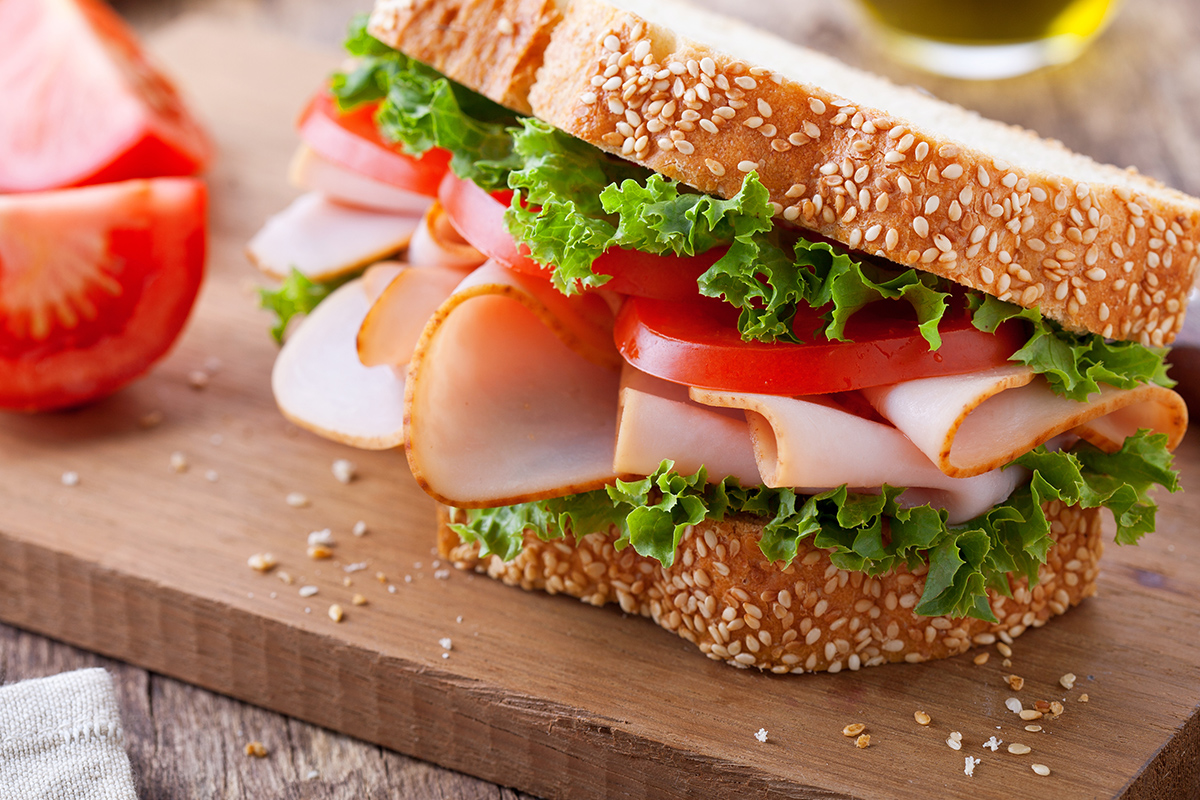
You actually need a good amount of carbohydrate and fat to provide the fuel for muscle building. Your total energy goal seems realistic, though your actual metabolism doesn’t follow an equation so your true calorie need may be higher or lower. Why not simply try to add 300-500 calories daily rather than keep track of five times that much? Simple foods like a turkey sandwich or apple with graham crackers and peanut butter could provide this energy. 

If you’re still having difficulty gaining lean mass, focus on energy dense foods (with little moisture or air) to get the most in every bite and consider adding a weight gainer shake. Cleaning your kids’ plates is also a great way to get extra calories! 

– Debbie J., MS, RD

This article should not replace any exercise program or restrictions, any dietary supplements or restrictions, or any other medical recommendations from your primary care physician. Before starting any exercise program or diet, make sure it is approved by your doctor.

Some questions have been edited for length and/or clarity.

Ask our Dietitian

Have a nutrition question? Our registered dietitian is ready to help!

Email nutrition@lafitness.com or submit your question below and it may be featured in an upcoming article!

4 + 12 =


Recommended Reading - Q+A

Newbie Gains and How to Maximize Them

Newbie Gains and How to Maximize Them

Newbie gains are said to be the rapid development of muscle strength and mass in people who are new to strength training. It can be observed in some but not in others. So, is it a real thing or is the muscle growth a result of something else? 

Thinking about it logically, it makes sense that the body would respond to a new workout regimen by packing on the gains to help you power through the new physical demands. For our readers however, we don’t rely purely on what seems to make sense, so we dug into the research to see what we could find. 

Let’s Look at the Facts

Genetics


Records from various studies show that there are many biological variables that influence the rate of muscle growth. There is enough of a difference that people are classified as low responders or high responders based on their individual ability to initiate muscle growth.1 This implies that newbie gains can be very dramatic for some and hardly noticeable for others, and that genetics are a major deciding factor. 

This doesn’t mean that, if you’re at a genetic disadvantage, you’ll never build muscle. It will just be a slower, more painstaking process. The idea behind successful Newbie Gains is that your body has the building blocks to increase muscle but has not needed to use them. When you start a consistent training program, you activate those building blocks which leads to fast muscle gain. Research indicates that people who experience rapid muscle growth likely have more of these building blocks or are even able to multiply them during exercise.1 

Nutrition


Another factor is your nutrition. Your calorie intake can either feed your muscles and help them grow or deprive your muscles from what they need and hold their growth at a plateau. Essentially, if your goal is to increase muscle size, your nutrition will look different than that of someone who is exercising to lose weight. You would need to consume more calories than you burn (as opposed to aiming for a calorie deficit) in order to promote muscle growth.2 

Men vs Women

Another note to consider is the difference between men and women. This study shows that after training, women had an advantage in strength gained, while men had a slight advantage in the gain of overall muscle size. Both adhered to 12 weeks of progressive resistance training, yet the results they saw were noticeably different. 

To summarize, some of the primary factors that impact rapid muscle growth include your genetics, your nutrition, and to an extent, your gender.  

How to Make the Most of Your Early Training Period

Now that we know some of the limitations, let’s peer into what you can do to make the most of your early strength training period. 

Keep it Consistent

Your body needs to have a reason to build muscle. If you train several days a week, your body is more likely to feel the need to build muscle because it’s consistently being asked to perform at a certain level. If you’re more sporadic about your workouts, you might still build muscle but much more slowly. 

Don’t Hit the Gym Too Hard

You don’t need to push your muscles to the breaking point (yet). When your body is new to exercise, pretty much everything is benefitting and strengthening your muscles. Once body weight exercises become easy, step it up to dumbbells. Once dumbbells get too easy, take on barbells. You don’t want your body spending all of its energy on repairing your muscles when it could be spending that energy on building them up. In other words, challenge yourself to give your muscles the incentive to grow but don’t overdo it. 

Eat Right

Our Registered Dietitian, Debbie James, has shared her wisdom on the right nutrition for bulking. Read her advice to learn what you can do to feed your body what it needs while you’re building muscle. 

How to Structure a Meal Plan for Bulking 

Increasing Body Weight for Bulking 

When Bulking Up Isn’t Working 

Bulking During High-Intensity Bike Training 

Now that you know what advantages you have as a beginner, it’s time to head to the gym! Let us know in the comments what progress you’re making in your strength training. For more interesting reads, subscribe to our newsletter to receive monthly highlights from the LA Fitness blog! 

Sources

  1. Roberts, Michael D, et al. “Physiological Differences Between Low Versus High Skeletal Muscle Hypertrophic Responders to Resistance Exercise Training: Current Perspectives and Future Research Directions.” Frontiers in Physiology, Frontiers Media S.A., 4 July 2018, https://www.ncbi.nlm.nih.gov/pubmed/30022953.


  2. Stoppani, Jim, and Joe Wuebben. “10 Nutrition Rules to Follow If You Want to Build Muscle.” Muscle & Fitness, www.muscleandfitness.com/nutrition/gain-mass/10-nutrition-rules-follow-if-you-want-build-muscle. 

Skin-Saving Nutrients You Need Now

Skin-Saving Nutrients You Need Now

Why Do We Get Wrinkles?

Nourishing your skin from the inside out often means focusing on collagen production (vs. consuming collagen supplements) since it’s the major component of connective tissue in tendons, skin and ligaments1,2.  Your dermis layer’s collagen serves to provide skin with structure, allowing skin to rebuild and repair, and to withstand stretching1, providing skin elasticity and tone2. Although it’s the most abundant protein in the body, as we age our natural production of collagen wanes3. Collagen fibers break down or no longer regenerate, which lead to dreaded wrinkles2. 

Collagen

Collagen is made up of several amino acids, predominantly the non-essential amino acids glycine, proline, hydroxyproline1,2, as well as alanine and arginine. Varying amino acid combinations make different types of collagen, so the collagen in skin (types I & III) is not the same as that in your joints (type II) or gut. In theory, boosting collagen production means furnishing your body with an adequate supply of amino acids from any protein source. However, the body prioritizes protein production to where it’s needed, say wound healing or antibodies for immunity, so it’s impossible to determine in advance where possible collagen peptides will be used in the body2. 

Still, consuming dietary sources of collagen ensures getting adequate amounts of hydroxyproline – the one amino acid not found in other proteins. Since collagen is concentrated in connective tissues, such as muscle, animal flesh (meat, fish, poultry, eggs) is a good source of collagen. Spirulina algae also contains collagen. Bone broth (which is simmered much longer than stock) also provides the amino acids necessary to build collagen2. 

Overall, dermatologists recommend a diet rich in nutrients and antioxidants to preserve skin health. Several play a key role in the production and maintenance of collagen to keep skin smooth and firm, while others protect against sun-induced skin aging and free radical damage in skin cells. Specifically, the skin-saving nutrients and phytochemicals to include regularly in your diet should be:  
Vitamin C

This antioxidant is a necessary cofactor in collagen synthesis and protects existing collagen from degradation2,4 and subsequent skin damage. Good food sources include citrus fruit, kiwifruit, peppers, strawberries, papaya, tomato juice, kale, cabbage, Brussel sprouts and broccoli4.

Vitamin E

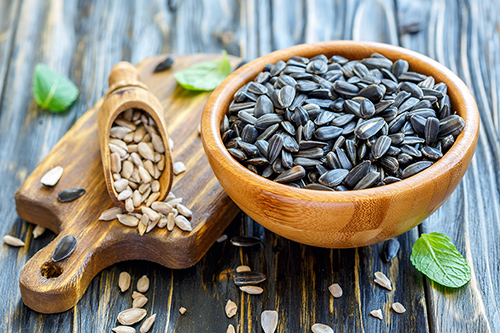
As with vitamin C, this antioxidant helps fights free radicals produced from sun exposure4. Sunflower seeds, almonds, avocado, wheat germ, sunflower oil and grapeseed oil are good sources.

Linoleic Acid

An essential fatty acid used in making ceramides to build a strong skin barrier4. Research also suggests that higher intakes may reduce skin aging4. It’s found in nuts and seeds, grapeseed oil, sunflower oil, safflower oil and canola oil.

Omega-3 Fats

This type of fat from fatty fish (such as salmon, trout and sardines) and certain plant oils (flaxseed, soybean, and canola) preserves collagen and reduces inflammation caused by ultraviolet rays4. 

Selenium

Found in Brazil nuts, mushrooms, wheat germ, sunflower seeds, turkey and seafood, this antioxidant mineral protects skin cells from free radical damage and guards against skin cancer4. 

Sulfur

A mineral commonly found in eggs, broccoli, onions, and garlic2 that’s needed for the structural formation of collagen.

Zinc

Foods such as red meat, poultry, beans, nuts, certain types of seafood, whole grains, and dairy products provide this necessary mineral co-factor for collagen production2. 

Flavenoids

These compounds in foods such as green tea, berries, beans and cocoa powder may reduce inflammation, improving skin elasticity and reducing wrinkles4. 

Water

The liquid of life helps maintain skin moisture, delivers nutrients to your skin, and flushes out toxins. 

Besides thinking about producing new collagen, it’s equally important to consider protecting existing collagen from damage and subsequent skin sagging. Lifestyle factors that negatively affect collagen integrity include smoking and sun and pollution exposure2.

Quitting smoking, wearing sunscreen and avoiding microscopic contaminants help to save your skin. A big dietary factor in skin aging is high sugar intake2 because the binding of sugar molecules to collagen fibers forms advanced glycation endproducts5, causing permanent damageTo prevent wrinkles, include only natural sugars in whole foods like fruit and milk, and avoid added sugars.

Sources

  1. WH Freeman and Company. Collagen: The Fibrous Proteins of the Matrix. Molecular Cell Biology, 4th Edition. ©2000 https://www.ncbi.nlm.nih.gov/books/NBK21582/ Accessed 11/15/2019 
  2. J Santa Cruz. Dietary Collagen — Should Consumers Believe the Hype? Today’s Dietitian, March 2019. Issue Vol. 21, No. 3, P. 26 
  3. Varani J, Dame MK, Rittie L, et al. Decreased collagen production in chronologically aged skin: roles of age-dependent alteration in fibroblast function and defective mechanical stimulation. American Journal of Pathology. 2006;168(6):1861–1868. doi:10.2353/ajpath.2006.051302 
  4. L Beck. “Can taking supplements or certain nutrients actually improve your skin?” The Globe And Mail. August 8, 2015. https://www.theglobeandmail.com/life/health-and-fitness/article-can-taking-supplements-or-certain-nutrients-actually-improve-your-skin/?cmpid=rss Accessed 11/15/2019. 
  5. Gkogkolou P, Böhm M. Advanced glycation end products: Key players in skin aging?. Dermatoendocrinology. 2012;4(3):259–270. doi:10.4161/derm.22028