Is There Such a Thing as Too Much Protein? | QA
Debbie James, RDN, helps answer a reader’s question about how much protein is too much for the body to process.



I’m trying to lose weight. I have been going to the gym about 5 times a week for about 4 months. I feel like I’m getting stronger, I have more energy and generally feel better. I noticed that I haven’t lost any weight and figured I should check my diet. Can you point me in the right direction?
– Jesse

First, keep in mind that muscle is denser than fat, so it weighs more. Getting more tone or noticing looser pants, but still seeing the same number on the scale could mean a gain in lean muscle plus fat loss. Hurray! Embrace your success in getting healthier.
If you still suspect your diet has problems, you probably know the reason why better than I’d guess. Common culprits that prevent weight loss are caloric beverages (especially alcohol, smoothies and gourmet coffee drinks), large portions and skipping meals. Here is a 10-point checklist of suggestions to help you identify where you might improve:
– Debbie J., MS, RD
This article should not replace any exercise program or restrictions, any dietary supplements or restrictions, or any other medical recommendations from your primary care physician. Before starting any exercise program or diet, make sure it is approved by your doctor.
Some questions have been edited for length and/or clarity.
 Have a nutrition question? Our registered dietitian is ready to help!
Email nutrition@lafitness.com or submit your question below and it may be featured in an upcoming article!
Debbie James, RDN, helps answer a reader’s question about how much protein is too much for the body to process.
Debbie James, RDN, helps answer a reader’s question on breakfast and working out.

Debbie James, RDN, helps answer a reader’s question on introducing teens to better nutrition.


I’m having major problems losing weight. Using MyFitnessPal to track calories. Consumed calories averages 1200. Exercise 400-600 per day. Alternate day’s cardio and weights. No major “wrong” foods etc. Weight constant at 159. Tried upping calorie to 1500 in case I was undereating but no change. What am I doing wrong, what do I need to change?
– Hemant P.
Since your age, height and weight are not stated, I’m unsure of your estimated energy needs. Definitely go with at least 1500 calories daily since you’ve not gained at that level. What those calories are comprised of matters a lot! Not knowing how you are actually eating, my general advice is to:


See our articles Am I Eating Too Little? | Q+A and Do you have any suggestions on small ways to increase the FIBER in my diet? for more insight.
– Debbie J., MS, RD
This article should not replace any exercise program or restrictions, any dietary supplements or restrictions, or any other medical recommendations from your primary care physician. Before starting any exercise program or diet, make sure it is approved by your doctor.
Some questions have been edited for length and/or clarity.

Want more? SUBSCRIBE to receive the latest Living Healthy articles right in your inbox!
Have a nutrition question? Our registered dietitian is ready to help!
Email nutrition@lafitness.com or submit your question below and it may be featured in an upcoming article!
Debbie James, RDN, helps answer a reader’s question about how much protein is too much for the body to process.
Debbie James, RDN, helps answer a reader’s question on breakfast and working out.
Debbie James, RDN, helps answer a reader’s question on introducing teens to better nutrition.
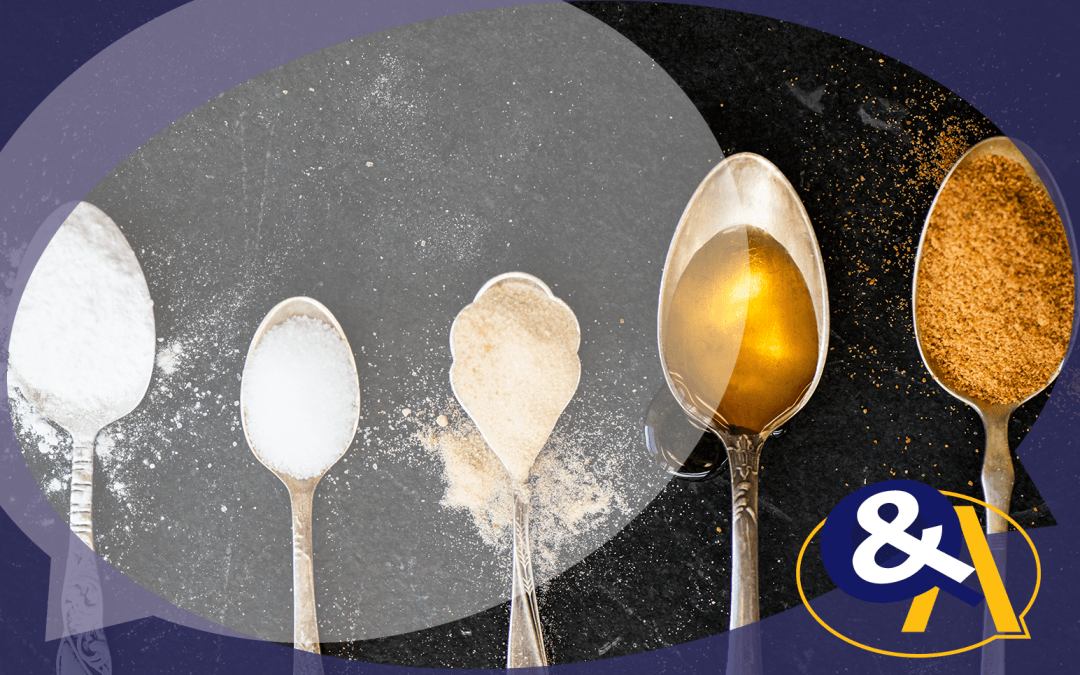
Find out nutrition tips below about sugar intake and where to get the best sugars from.

What is the high and low for a healthy daily sugar consumption?
-Michael B.

“Sugar” includes small carbohydrate compounds, both natural and added. Let’s start with natural…
Natural sugars such as fructose and lactose comprise 50-100% of the calories from fruit and non-fat milk and 25% calories from some vegetables, so they make up a small base portion of the diet. There are minimal sugars in protein sources (egg, meat, fish, poultry) and most unprocessed starches (e.g. rice, oats), while none in pure fats. Natural sugars are not restricted – there are healthy fruitarians – although I will say that traditional strained juices are not recommended, and only endurance/pro athletes can probably balance out their diet while still eating 5+ servings of fruit.

Added sugars, either for flavor or structure, are what we are concerned with. Corn syrup, table sugar, beet or cane sugar, honey, molasses, agave syrup and concentrated fruit juice are from natural sources, but used as sweeteners in food products and recipes. There are many diets that may reflect the newest 2015 US Dietary Guidelines for sugar consumption, including vegetarian, Mediterranean, higher-protein/modest carbohydrate, and medically prescribed patterns. Each one can affect an energy balanced diet with no more than 10% of daily calories coming from added sugars. This would be the high that you refer to in your question.
The limit is not a free license to eat ‘clean’ for a week then splurge on a dessert buffet, sending your body into a blood sugar spike. We’re talking about daily balance. A teaspoon of jam on toast, a drizzle of caramel in coffee, a splash of honey mustard dressing on a salad, and a tablespoon of sweet Thai chili sauce on salmon could hit the 10% mark for added sugar in a smaller diet. The idea is to consume your needed amounts of healthy protein, carbohydrate and fats, then only add sugars to meet your remaining calorie goals if not already met.
On the low end, you can survive without any sugar whatsoever if you eat enough other carbohydrates, but you’d be missing all the benefits from fruits, milk products and several vegetables which would NOT be healthy. No added sugar is certainly possible, though! It just means avoiding most condiments (think ketchup, teriyaki, marinara, BBQ sauce, dressings), sport or soft drinks, and processed foods, while eating wholesome mostly home-prepared foods. The result would not necessarily be bland. For example, oatmeal could be sweetened with dried fruit and cinnamon, meats can be marinated in vinegar or dry-rubbed, plain yogurt can be jazzed up with berries and nuts, and pasta can be dressed with diced tomatoes, garlic and olive oil.
Let us know the successes you’ve had in reducing added sugars by commenting below!
– Debbie J., MS, RD
This article should not replace any exercise program or restrictions, any dietary supplements or restrictions, or any other medical recommendations from your primary care physician. Before starting any exercise program or diet, make sure it is approved by your doctor.
Want more? SUBSCRIBE to receive the latest Living Healthy articles right in your inbox!

Cycling is not just about the time spent on the saddle; it’s also about the power you can generate with each pedal stroke. Strength training is an essential component for cyclists looking to improve their performance, endurance, and overall cycling efficiency. A...

In your quest for “yoga studios near me,” you’ll discover that LA Fitness clubs nationwide provide a tranquil haven for mental and physical well-being. With a variety of yoga classes tailored to meet the needs of every member, from beginners to seasoned yogis, LA...

Cue the sound of a revving engine… running your blender at home can bring goodness with that whirring noise! Creating your own smoothies is a great way to get in some nutrients and plant phytochemicals you otherwise wouldn’t during the day. It allows you to prepare...

Have a nutrition question? Our registered dietitian is ready to help!
Email nutrition@lafitness.com or submit your question below and it may be featured in an upcoming article!

I have been a member since May of this year and love the facility in Florence, KY. Over all I have went from 319 to 235 with about 50 lbs lost at LA. I am basically at my goal weight and have begun to lift using free weights and the hoist and hammer equipment. I noticed an immediate change in muscle but then leveled off. I am researching my diet as it is still more geared to weight loss. I am 6’4” male, I have been on a high protein very low carb diet about 2000-2400 cals. I am looking to keep my caloric intake about the same but switch to about 150g of carbs a day 200-230g of protein and 60-70 grams of fat.
What is your opinion on this plan? Thanks for any help. I lift 3-4 days a week for an hour usually followed by 20-30 minutes of cardio on the elliptical or treadmill, I try to do 10 minute miles with a heart rate of 140-150 if that matters. I have also read I should lift and do light cardio and then rest for 48 hours at least on the weights and do more intense cardio on non lifting days.
-Robert M.
Hi Robert – Good to hear of your success at your local LA Fitness club! The plan you describe would provide about 30% carbohydrate, 39% protein at 1.9 gm/kg, and 31% fat in 2030 calories (at lowest protein and highest fat given). This seems a suitable transition from your previous diet.
I am having success losing weight, but could you review my strategy to see if it is my best option?
Since you are more active than you were 5 months ago, you may need more carbohydrates to retain your muscle mass, but can add these in the future. For maximum benefit from the carbs you are eating, shoot for 25 grams of fiber per day. The produce, grains and beans needed to provide that amount won’t leave room for refined sugars anyway. You don’t need more than 200 grams protein daily as that’s about the maximum which is utilized by muscle, while the remainder would be burned for fuel (which is carbohydrate’s job). The amount of fat is ideal for now but could be slightly increased if you end up needing more energy – as long as it’s mostly from unsaturated plant sources.
Keep up the good work!
– Debbie J., MS, RD
This article should not replace any exercise program or restrictions, any dietary supplements or restrictions, or any other medical recommendations from your primary care physician. Before starting any exercise program or diet, make sure it is approved by your doctor.

We're "Trimming the Fat and Keeping the Muscle" on today's episode of the Living Healthy Podcast! On this episode of the Living Healthy Podcast, just in time for Thanksgiving, we learn about trimming or "cutting" the fat after you finish the bulking phase. This is the...

Today’s episode is all about Busting Gym Myths! Does spot training really work? Is Cardio the best way to burn fat? We talk to Master Trainer Jordan Jones to find out the answers, so buckle up because you might just get your bubble popped. Sorry about that!

September is Yoga Awareness Month, a perfect time to explore the incredible benefits of yoga and how it can enhance your life. Whether you’re a seasoned yogi or a beginner, this month is all about embracing the practice and discovering its transformative power. The...
Have a nutrition question? Our registered dietitian is ready to help!
Email nutrition@lafitness.com or submit your question below and it may be featured in an upcoming article!
Want more? SUBSCRIBE to receive the latest Living Healthy articles right in your inbox!

Hi Nutrition Folks,
I’ve heard the mantra about 8 glass of water/day. I have a hard time getting excited about drinking so much plain water every day. I mean, it’s just so plain. I love drinking unsweetened iced tea and can easily kick back 8 glasses of that every day or a mix of tea and water. I don’t notice any negative effects from the caffeine in the tea.
If I stick to iced tea am I really losing out on the health benefit?
-Todd W.
You’re not losing out! A person’s fluid needs can be met in various ways and with little straight water. Beverages on average provide 95% free water, but thick smoothies or shakes have less – maybe 75% water.
As a habitual consumer of iced tea, you probably have a tolerance to the diuretic effects of caffeine. Plus, the volume is spread throughout the day so your beverage choice is fine. Remember your ice cubes are water, too!
To determine how much liquid you should be drinking, multiply your weight in pounds by 0.5 to get the recommended fluid ounces. Then divide by 8 (the # of fluid ounces per cup) to figure out how many cups that equates to.
– Debbie J., MS, RD
This article should not replace any exercise program or restrictions, any dietary supplements or restrictions, or any other medical recommendations from your primary care physician. Before starting any exercise program or diet, make sure it is approved by your doctor.
September is Yoga Awareness Month, a perfect time to explore the incredible benefits of yoga and how it can enhance your life. Whether you’re a seasoned yogi or a beginner, this month is all about embracing the practice and discovering its transformative power. The...
Cue the sound of a revving engine… running your blender at home can bring goodness with that whirring noise! Creating your own smoothies is a great way to get in some nutrients and plant phytochemicals you otherwise wouldn’t during the day. It allows you to prepare...

With so many sources offering nutrition advice, it’s hard to know what’s true. Even factual information can become distorted by the time it reaches you. Like a game of telephone, the message often changes as it’s passed along. Here, we debunk 5 common diet myths to...
Have a nutrition question? Our registered dietitian is ready to help!
Email nutrition@lafitness.com or submit your question below and it may be featured in an upcoming article!
Want more? SUBSCRIBE to receive the latest Living Healthy articles right in your inbox!